You Won’t Believe What I Captured in Rabat—Food Scenes That Stole My Lens
Rabat isn’t just Morocco’s quiet capital—it’s a visual feast hiding in plain sight. I went looking for history, but ended up chasing food stories through alleyways, markets, and family tables. Every tagine steam, spice pile, and street vendor’s hands became a frame worth freezing. Through my lens, Rabat’s soul spilled out in saffron yellows, cumin reds, and the golden glow of shared bread. This is food culture not just tasted—but truly seen.
Arrival in Rabat: A Photographer’s First Impressions
Stepping off the train into Rabat’s central station, I was met not with the clamor of Marrakech’s Jemaa el-Fna or the urban pulse of Casablanca, but with a calm that felt almost intentional. The city unfolded in soft gradients—white-washed walls glowing under Atlantic light, cobalt-blue doors nestled between archways, and bougainvillea spilling over low garden walls. My original plan had been architectural: to document the harmony between French colonial lines and Andalusian influences, the quiet elegance of Hassan Tower against a pale sky. But within hours, the rhythm of Rabat shifted my focus. It wasn’t the monuments that held my attention—it was the smell of cumin drifting from open kitchen windows, the clink of mint tea glasses in corner cafes, and the sight of elderly women balancing baskets of fresh bread on their heads. The pace here allowed space for observation. Unlike cities that demand your attention through noise and motion, Rabat offers moments in stillness. That stillness, I soon realized, was where food stories lived—not staged, not performative, but woven into the everyday.
What struck me most was how food anchored the city’s tempo. Morning unfolded with the arrival of flatbreads from communal ovens. Midday brought families gathering around steaming tagines. Evenings were marked by the sizzle of grilled sardines along the Bouregreg River. These weren’t tourist performances; they were rituals repeated across generations. My camera, initially pointed at minarets and gateways, began turning toward kitchen doorways, spice sacks, and weathered hands shaping dough. The architecture was beautiful, yes—but the real structures were made of tradition, flavor, and shared memory. Rabat taught me that the most compelling photographs often emerge when you let go of the itinerary and follow your senses.
The Rhythm of the Medina: Where Food Meets Daily Life
The old medina of Rabat doesn’t shout. It murmurs. Its alleys are narrow, lined with stalls stacked high with olives in every shade of green and black, barrels of preserved lemons glowing like amber, and mounds of hand-ground ras el hanout piled into perfect pyramids. Walking through it felt less like visiting a market and more like stepping into a living kitchen. Here, food isn’t a commodity—it’s a language. Vendors greet each other with news of harvests, exchange recipes with a nod, and measure spices not by weight but by generations of instinct. I remember one morning watching a woman arrange dates by size and color, her fingers moving with the precision of an artist. When I raised my camera slightly, she smiled—not at the lens, but at the recognition. That moment became one of my favorites: not a posed portrait, but a silent acknowledgment of shared appreciation.
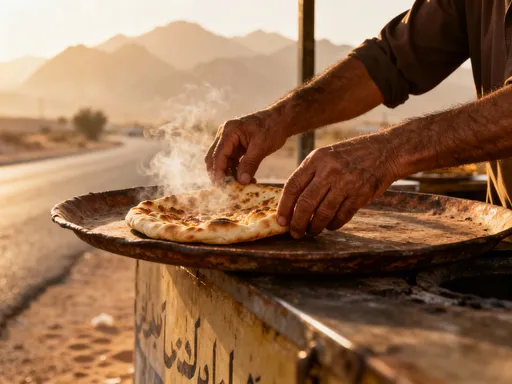
One of the most striking features of the medina is the presence of communal ovens, known locally as four. Each morning, families bring their dough—some plain, some spiced with anise or sesame—and place it in shared clay ovens heated with wood. The process is both practical and deeply social. Women gather in clusters, chatting while they wait, children darting between legs, and the air fills with the warm scent of baking bread. I spent an entire morning photographing this ritual from a respectful distance, waiting for the right light and the right moment. What I captured wasn’t just the act of baking—it was the quiet intimacy of community. These ovens are more than culinary tools; they are gathering places, anchors of neighborhood life. Unlike tourist-centric souqs where performances begin the moment a camera appears, Rabat’s medina continues its rhythm regardless of onlookers. This authenticity is what makes it so compelling to photograph—the stories are real, unfiltered, and unfolding naturally.
Breakfast Like a Local: Capturing Morning Rituals
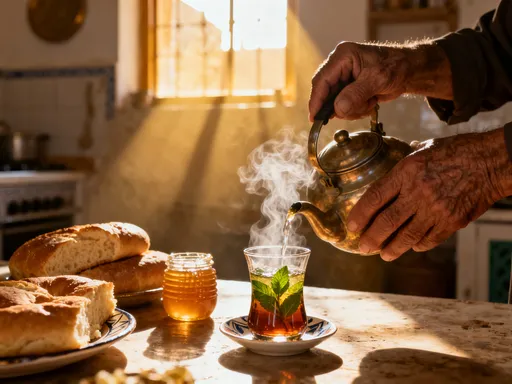
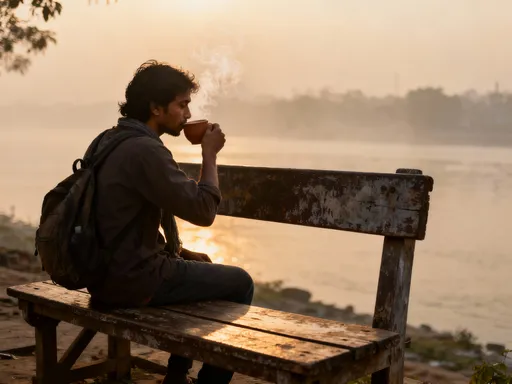
There is a small café near the Kasbah des Oudaias that opens before sunrise. No sign, no menu—just a counter, a few metal tables, and the constant hum of a tea kettle. This is where locals begin their day: with thick glasses of steaming mint tea, flaky msemen drizzled with honey, and olives from the night before. I arrived early one morning, camera in hand, hoping to catch the soft light filtering through the green-striped awning. What I found was even more beautiful: a quiet ceremony of warmth and routine. An elderly man sat in the same corner every day, reading the paper while dipping bread into olive oil. A group of schoolchildren shared a single plate of harira soup, laughing between sips. The owner, a man named Ahmed, moved behind the counter with the ease of someone who had done this for decades.
Photographing breakfast here was both a technical and emotional challenge. The light was low, diffused through fabric and smoke from the grill. I used a prime lens with a wide aperture to capture detail without disturbing the scene. My goal wasn’t to create perfect compositions, but to document the truth of these moments—the steam rising from tea glasses, the crumpled napkins on tables, the way a woman’s hands paused mid-sentence as she listened to her friend. These are the details that tell a story. One image that still moves me shows a young mother feeding her toddler a piece of warm mlaoui, their faces lit by a sliver of morning sun. There’s no grandeur in the frame, no exotic backdrop—just love, nourishment, and the ordinary beauty of a shared meal. That’s what I learned in Rabat: the most powerful photographs often come from the simplest moments.
Market Magic: Shooting the Soul of Rabat’s Food Culture
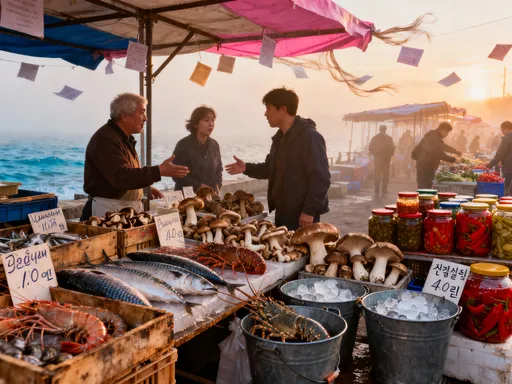
The covered souqs of Rabat are where food becomes art. Stalls are arranged like still-life paintings: pyramids of saffron and turmeric, baskets of figs arranged by ripeness, and glass jars filled with pickled vegetables in radiant hues. I remember standing for nearly an hour watching a spice vendor reorganize his display after a delivery. He didn’t just stack the sacks—he created patterns, contrasted colors, and labeled each with hand-written tags. When I asked if I could photograph him, he nodded and continued his work, treating the camera as just another observer in his daily theater. That’s the key to photographing markets here: you must become part of the background, not a disruption.
Respect is non-negotiable. I never shoot without permission, and I always approach with eye contact and a smile. In Rabat, people respond to patience. If you linger, show genuine interest, and ask in broken Arabic or French, most will welcome you. I’ve learned to wait—not just for the light, but for the moment when a vendor laughs, when a child reaches for a date, when hands exchange coins for fresh herbs. Those are the frames that carry soul. Technically, I rely on a 50mm prime lens for its clarity and discreet size. Zoom lenses feel intrusive; a compact setup allows me to move quietly through crowded lanes. Timing matters, too. Mid-morning offers the best light—soft and directional—and the market is busy but not overwhelming. By afternoon, the heat flattens the shadows, and the colors lose their depth.
One of my most treasured images came from a simple exchange. An elderly woman sold homemade harcha, a semolina bread cooked on a griddle. She worked slowly, her hands cracked from years of kneading. I asked if I could take a photo. She agreed, then paused, wiped her hands, and arranged the bread into a perfect circle. It wasn’t for show—it was pride. That image, titled “Bread and Dignity,” now hangs in my studio. It reminds me that every photograph is a collaboration. In Rabat, the market isn’t just a place to buy food—it’s a living archive of taste, labor, and identity.
Home Cooking: A Kitchen Invitation Behind Closed Doors
Some of the most profound moments of my trip came not in public spaces, but behind closed doors. Through a local guide, I was invited into the home of Fatima, a grandmother in her sixties who had cooked for her family for over forty years. Her kitchen was small, tiled in blue and white, with a single window overlooking a courtyard where jasmine climbed the walls. The day I visited, she was preparing a lamb tagine with prunes and almonds—a dish she learned from her mother. What struck me wasn’t just the recipe, but the ritual. The meat was marinated overnight. The spices were ground by hand. The tagine pot was heated slowly, covered with a cone-shaped lid to trap steam.
Photographing in the kitchen was challenging. The light was uneven, coming only from the window and a single bulb. I had to move slowly, using natural light and high ISO settings to preserve the mood. But the real challenge was emotional: entering someone’s private space requires trust. I spent the first hour simply talking, drinking tea, and watching. Only when Fatima felt comfortable did I begin to shoot. What emerged were not just images of food, but of legacy. I captured her granddaughter watching intently as Fatima shaped dough, her hands mirroring the older woman’s. I photographed the moment the tagine was lifted, releasing a cloud of saffron-scented steam. And I recorded the laughter around the table as the family gathered, passing dishes without ceremony.
This experience transformed my approach. In tourist-heavy cities, food photography often feels performative—dishes staged, smiles rehearsed. But here, the meal was real, unposed, and deeply meaningful. Fatima didn’t cook to impress; she cooked to connect. Her kitchen wasn’t a set—it was a sanctuary. By the end of the day, I wasn’t just a photographer—I was a guest, a witness to something sacred. These are the stories that matter: not the exotic, but the enduring. Not the spectacle, but the soul.
Street Food Gems: Flavor and Framing After Dark
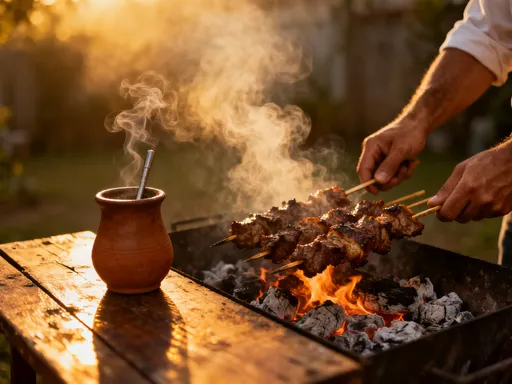
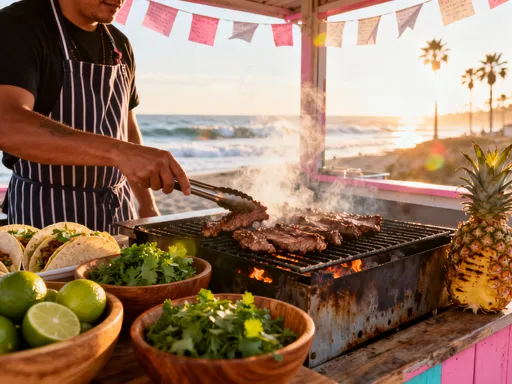
As the sun dips below the Atlantic, Rabat’s waterfront comes alive with the sizzle of grills and the glow of street lamps. Along the Corniche, vendors set up simple stands: metal trays, charcoal burners, and stacks of fresh sardines caught that morning. This is where the city eats after dark—not in restaurants, but on plastic stools under the stars. I arrived one evening with my camera, drawn by the smell of grilled fish and cumin. The scene was cinematic: smoke curling into the night air, hands flipping sardines with practiced ease, customers leaning in to catch the last drops of lemon juice.
Night photography in Rabat is both rewarding and delicate. The light is dramatic—shadows stretch across faces, and the golden glow of lanterns highlights textures. I used a 35mm lens to capture wider scenes, allowing the environment to tell part of the story. One image that stands out shows an elderly vendor, his face lined with years of sea wind, concentrating as he brushes oil onto fish. The background is blurred, but his hands are sharp, telling a lifetime of labor. I didn’t ask for a pose. I waited. And when he looked up, not at me but at the sky, I pressed the shutter.
Respect remains essential, especially at night. I always approach slowly, speak politely, and offer to buy food before taking photos. In return, I’m often invited to sit, to share a plate, to become part of the moment. One vendor, after seeing my photos, smiled and said, “You see what others walk past.” That’s the heart of street food photography—not exploitation, but elevation. These vendors aren’t just selling meals; they’re keeping traditions alive, one grilled sardine at a time. By photographing them with dignity, we honor their work and preserve a culture that might otherwise go unseen.
Why Rabat’s Food Stories Matter—And How to Tell Them Right
Documenting food culture is about more than aesthetics. It’s an act of preservation. In Rabat, every dish carries history—Berber roots, Arab influences, Andalusian echoes. The way a woman folds msemen, the blend of spices in a tagine, the rhythm of tea pouring—these are living traditions, passed down through touch and taste. But they’re also fragile. Globalization, tourism, and urban change threaten to dilute or commodify them. As photographers, we have a responsibility: to capture not just what food looks like, but what it means.
That means resisting the urge to exoticize. Rabat’s food culture isn’t “quaint” or “picturesque”—it’s real, functional, and deeply personal. I’ve seen tourists stage scenes: asking vendors to “look traditional,” paying for posed shots, treating people like props. This does harm. It reduces culture to costume. Instead, I advocate for slow photography—spending time, building relationships, listening before shooting. Let the moment unfold. Wait for the genuine laugh, the unguarded gesture, the quiet act of care. These are the images that endure.
It also means giving credit. When I share photos, I name the people when possible, honor their stories, and avoid captions that turn tradition into spectacle. Photography can be a bridge, not a barrier. In Rabat, I didn’t just take pictures—I participated. I ate with families, learned recipes, and carried home more than images: I carried understanding. For fellow travelers and photographers, my advice is simple: come with curiosity, not assumptions. Let the city guide you. Follow the smell of bread, the sound of grinding spices, the warmth of an invitation. Rabat doesn’t need to be loud to be powerful. Its beauty is in the details—in the way a grandmother teaches her granddaughter to knead dough, in the steam rising from a shared tagine, in the quiet dignity of daily life.
Rabat is an underrated visual treasure, not because it’s flashy, but because it’s honest. It invites you to look closely, to slow down, to see beyond the postcard. The food scenes I captured weren’t staged for my lens—they were lived, loved, and shared. And in that sharing, I found not just great photographs, but a deeper connection to a culture that values patience, tradition, and the simple act of breaking bread together. For anyone seeking not just to travel, but to understand, Rabat offers a quiet but profound lesson: the heart of a place is often found not in its monuments, but in its kitchens, markets, and hands that feed.”