You’ve Never Tasted Kolkata Like This – Slow Travel, Real Flavors
Kolkata isn’t just a city—it’s a sensory journey. I spent two weeks moving slowly through its lanes, savoring more than just food. From steaming plates of kathi rolls at dawn to family-run sweet shops that have been around for generations, every bite told a story. This isn’t about ticking landmarks off a list. It’s about lingering over chai with strangers, tracing recipes through neighborhoods, and discovering how flavor shapes a city’s soul. Let me take you where the map doesn’t reach.
Why Kolkata? The Allure of Slow Travel in Eastern India
Kolkata offers a rare invitation in the world of modern travel: the chance to move slowly, breathe deeply, and engage meaningfully. Unlike cities that reward speed and efficiency, Kolkata unfolds best when approached with patience and presence. Its rhythm is shaped by the gentle flow of the Hooghly River, the unhurried footsteps of morning walkers along the ghats, and the steady clang of trams echoing through colonial-era streets. This is a city where life is lived in full view—on sidewalks, in courtyards, around shared meals—and where the most profound experiences are often found not in guidebooks, but in spontaneous moments of connection.
What makes Kolkata particularly suited to slow travel is its layered cultural fabric. Centuries of trade, migration, and tradition have woven a culinary and social tapestry that cannot be rushed. The city has long been a crossroads—of Bengali, Mughal, British, Chinese, and Armenian influences—each leaving behind flavors, rituals, and ways of living that continue to thrive. To truly understand Kolkata, one must step beyond the tourist trail and into its residential lanes, where life unfolds at a human pace. Here, mornings begin with incense drifting from household altars, and evenings are marked by the aroma of frying luchi rising from open kitchen windows.
Slow travel in Kolkata is not merely a style of tourism; it’s a return to the essence of what travel once was. It means spending days in a single neighborhood, returning to the same tea stall each morning, learning the names of vendors, and being recognized. It means accepting an invitation to a home-cooked meal not because it’s on an itinerary, but because a conversation over mishti led to a shared laugh. This kind of immersion allows travelers to witness the city’s soul—not as performers for visitors, but as people living full, rich lives. The reward is not a checklist of sights, but a deeper sense of belonging, even if only for a short while.
Arrival & First Impressions: A City That Moves to Its Own Beat
Stepping off the train or plane into Kolkata’s warm, spice-scented air is like entering a different dimension of time. The first sensation is often one of sensory overload—the honking of cycle rickshaws, the rhythmic pounding of choppers in open-air kitchens, the vibrant hues of flower garlands at street shrines. But beneath the surface chaos lies a quiet order, a rhythm that reveals itself only to those willing to slow down. My first morning in the city began at a roadside tea stall near Esplanade, where I sat on a wooden bench beside office workers sipping steaming cups of masala chai. There was no rush, no pressure to move on. Conversations flowed easily, punctuated by laughter and the occasional shared biscuit.
One of the most striking aspects of Kolkata’s daily life is the artistry embedded in its street food culture. Watching a phuchka vendor assemble each hollow puri with precision—filling it with tamarind water, mashed potato, and spices—is like witnessing a performance. Their hands move with the confidence of decades of practice, their stalls functioning as both kitchen and stage. These moments are not staged for tourists; they are part of the city’s living fabric. I found myself returning to the same phuchka stall three days in a row, not just for the burst of tangy, spicy flavor, but for the quiet acknowledgment from the vendor—a nod, a smile, the extra pinch of roasted cumin he began adding just for me.
Another defining feature of Kolkata’s first impression is its warmth—both in climate and in human connection. Strangers ask where you’re from, not out of curiosity alone, but with genuine interest. A retired schoolteacher once invited me to sit with him near the Maidan, where we watched children fly kites and he spoke softly about the city’s changing skyline. “It grows taller,” he said, “but the heart is still in the lanes.” That heart beats in the small moments: the scent of roasted peanuts on a winter evening, the sound of a harmonium drifting from a neighborhood puja hall, the way a street dog curls up beside a tea vendor’s stool, accepted as part of the daily cast.
The Heart of the Meal: How Food Weaves Community Here
In Kolkata, food is never just about nourishment. It is memory, identity, and relationship—all served on a banana leaf or a chipped porcelain plate. Meals are communal events, often shared across generations and boundaries. During my stay, I was invited to a family iftar in the Burrabazar neighborhood, where a Muslim household opened their home to neighbors of all faiths. The table groaned under the weight of biryanis, kebabs, fruit chaat, and sheer khurma. What struck me most was not the abundance, but the ease with which people gathered—Bengali aunties chatting with young students, elders blessing children before the meal began. Food here is a bridge, not a barrier.
Street food stalls function as informal community centers, where regulars gather not just to eat, but to talk, argue, and laugh. A single phuchka cart might serve as a morning meeting point for delivery workers, a lunchtime refuge for office clerks, and an evening hangout for college students. These spaces are democratic—everyone sits on plastic stools, everyone eats with their hands, and everyone is equal in the face of a perfectly crisp puri. In North Kolkata’s Shyambazar, I met a group of retirees who meet every evening at a decades-old jhal muri stand. “We’ve been coming here for forty years,” one told me. “The stall changed hands twice, but the taste? Same as always.”
The city’s cuisine also reflects its multicultural heritage. In Tiretti Bazar, Kolkata’s historic Chinatown, descendants of Hakka migrants still run small restaurants serving dishes like chilli chicken and Hakka noodles, adapted over generations to local tastes. Nearby, Armenian churches stand beside Sufi shrines, and the scent of rosewater from a bakery specializing in Christian Easter cakes mingles with the aroma of biryani from a nearby Muslim-run eatery. These flavors coexist not as exotic curiosities, but as natural parts of the city’s daily life. To eat in Kolkata is to taste harmony—diverse traditions living side by side, each contributing to the whole.
A Week in the Kitchen: Learning from Local Cooks
One of the most transformative experiences of my journey was spending time in home kitchens across Kolkata. In Kumortuli, a neighborhood known for its clay idol makers, I was welcomed into the home of a potter’s wife who insisted I learn to make mishti doi, the sweetened yogurt that is a staple at festivals. We sat on the floor, grinding cardamom with a stone mortar, boiling milk slowly in a heavy-bottomed pan, then straining it through muslin cloth. “The secret,” she said, “is in the simmer—too fast, and it curdles; too slow, and it loses its soul.” Her hands moved with a rhythm born of repetition, each gesture precise, each step deliberate.
In another home, in the bustling lanes of Maniktala, I learned to shape puchkas from a grandmother who has been making them for over fifty years. Her kitchen was small, lit by a single bulb, but every tool had its place—a steel bowl for tamarind water, a wooden spoon for mashing potatoes, a cloth bag for storing spices. She taught me how to balance the fillings so the puri wouldn’t burst, how to adjust the spice level for different palates, and how to serve them quickly before the shell softened. “Speed is skill,” she said, “but care is what makes it good.” By the end of the afternoon, my fingers were stained with turmeric, my clothes carried the scent of cumin, and I had earned not just a recipe, but a connection.
These kitchen sessions were never transactional. No money changed hands, no cameras were set up for content. They were acts of sharing, of trust. In each home, I was offered tea before we began, asked about my family, listened to with genuine interest. Cooking became a language beyond words—a way to communicate care, history, and pride. I left each home with more than a notebook full of recipes; I carried the weight of stories, the warmth of inclusion, and the understanding that food, when made with love, is never just food.
Neighborhood Bites: Mapping Flavors Block by Block
Kolkata’s culinary map is best explored on foot, one neighborhood at a time. In Old Chinatown, tucked between narrow lanes and shuttered warehouses, a small eatery run by a third-generation family serves luchi and alur dom—puffed fried bread paired with spiced potato curry. The luchi rises like a golden balloon, crisp on the outside, soft within, while the alur dom simmers for hours with cinnamon, bay leaf, and a hint of poppy seed paste. There are no signs, no online listings—only word of mouth and the steady stream of customers who know exactly where to go.
In Kalighat, near the famous Kali temple, sweet shops sell offerings that double as street snacks. One century-old confectionery specializes in langcha, a deep-fried sweet dumpling soaked in sugar syrup, and sitabhog, a fragrant rice-based dessert. These are not mass-produced treats but handcrafted with care, often prepared before dawn to be offered at the temple and sold to visitors by mid-morning. The owner, a soft-spoken man in his seventies, explained that the recipes have been passed down unchanged for over a hundred years. “We don’t innovate,” he said. “We preserve.”
North and South Kolkata offer contrasting dining cultures. In the north, meals are often hearty and spice-forward—think kathi rolls stuffed with mutton, or hilsa fish curried with mustard paste. In the south, particularly in neighborhoods like Ballygunge and Gariahat, the style leans toward refinement: delicate sweets, lighter gravies, and a greater emphasis on presentation. A tucked-away biryani stall known only to locals in Tollygunge serves a version layered with saffron, caramelized onions, and tender goat meat, cooked in a sealed pot over a wood fire. No menu, no seating—just a window where orders are called out and packages handed over with a smile.
The Rhythm of the Streets: Timing Your Days Like a Local
To eat like a Kolkatan, one must follow the city’s natural rhythm. Mornings begin early, with kochuri—deep-fried bread—best enjoyed fresh from the tawa by 8 a.m. By midday, the city shifts toward biryani, with certain stalls drawing lines well before noon. Evenings belong to phuchka, best eaten as the sun sets and the streetlights flicker on. This rhythm is not dictated by clocks, but by tradition, appetite, and the availability of fresh ingredients. To align with it is to travel not just through space, but through time.
Transport in Kolkata enhances this experience. Walking allows you to notice the small details—the steam rising from a freshly opened batch of steamed momos, the sound of a knife chopping onions in a roadside stall. Trams offer a nostalgic glide through historic neighborhoods, their bells ringing as they pass colonial buildings and bustling markets. Short rickshaw rides—often no more than five or ten minutes—connect food destinations while offering brief conversations with drivers who know every hidden gem. The key is flexibility: a missed tram might lead to an unplanned stop at a flower market, where a vendor shares a piece of ripe mango and a story about monsoon blooms.
Patience is essential. Dishes may take time, stalls may close early, and plans may change. But these moments of delay often yield the richest experiences—a shared umbrella during a sudden downpour, a conversation with a fellow diner waiting for the same dish, a spontaneous invitation to a nearby home. Slow travel in Kolkata is not about efficiency; it’s about presence. It’s about learning to appreciate the pause, the unexpected, the unplanned detour that becomes the highlight of the day.
Beyond the Plate: How Slow Eating Changes How You See
After two weeks of eating, cooking, and sharing meals in Kolkata, I noticed a shift—not just in my palate, but in my perception. Slowing down to savor each meal had trained me to pay attention in new ways. I began to notice the texture of a freshly ground spice, the sound of a mortar striking stone, the way light fell across a courtyard during afternoon tea. Mindful eating had become mindful living. I was no longer just observing the city; I was feeling it, absorbing it, becoming part of its rhythm.
This transformation extended to my relationships. The vendor who once handed me a kathi roll without a word now greeted me by name. The tea stall owner began saving a seat for me each morning. These small acknowledgments signaled a deeper integration—not as a visitor, but as someone recognized, accepted. I had not changed the city, but the city had changed me. I carried with me a quieter mind, a fuller heart, and a renewed belief in the power of simple human connection.
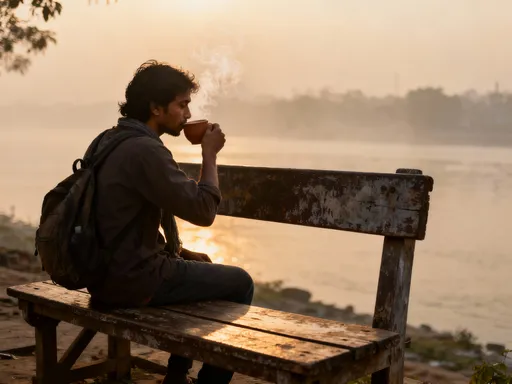
My final morning in Kolkata began at dawn on the Ganga ghats. I sat on a stone step, wrapped in a shawl, watching the river shimmer under the rising sun. A local man offered me a plate of warm jalebis and a cup of sweet tea. We didn’t speak much, but none was needed. In that quiet moment, with the city slowly waking around us, I felt a deep sense of gratitude—not just for the food, but for the journey, the people, the belonging. Slow travel in Kolkata had given me more than flavors. It had given me a new way of seeing, and a reminder that the richest experiences in life are often the ones we don’t rush to consume.